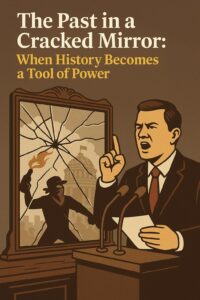

Every time Indonesia enters a heated political season, officials suddenly morph into amateur historians. History meant to be a space for learning becomes a stage for propaganda. Fragments of the past are stitched together at will, often exaggerated, then paraded as a rationale for today’s hunger for power. They quote Bung Karno, name drop Tan Malaka, and even slip in figures like Sheikh Nawawi, Bagus Rangin, or Prince Diponegoro despite having values that starkly contradict theirs. History ceases to be a mirror for reflection and becomes a mask to hide the increasingly arrogant face of authority.
This phenomenon is far from new. Since the Reformasi era, the manipulative use of history has become a convenient tool to stifle criticism and dress up populist rhetoric. The 1998 Reform movement, for instance, is more often recited as a slogan than honored as a commitment. Some officials, once part of the repressive regime, now style themselves as heroes of the transition. Meanwhile, the youth are fed a one dimensional narrative: that democracy today is the gift of elites, not the hard won result of bloodied collective struggle in the streets.
More troubling still, today’s rulers freely snatch historical symbols out of context. Official speeches are peppered with names like Soekarno, Hatta, and Sudirman but their spirit of humility and service is buried beneath bloated budgets, grandiose vanity projects, and hedonistic lifestyles. Leaders speak of economic sovereignty, yet roll out red carpets for oligarchs. They trumpet mental revolutions while tolerating bureaucracies riddled with corruption and nepotism.
History as Political Commodity
In campaign speeches and on billboards, politicians revive a romanticized past: “we are a great nation that once reigned supreme,” or “we inherit the glory of Majapahit and Sriwijaya.” But that glory is used as mere cosmetics. There’s no serious effort to read history critically no reflection on how those kingdoms fell due to elite greed and moral decay. What remains is symbolic memory twisted to suit narratives: temples become selfie backdrops for officials, not cautionary tales of collapse.
This mirrors the fate of classical Islamic history. After the decline of the three great caliphates Umayyad, Abbasid, and Fatimid the Muslim world entered the Mulk al Tawā’if era: a time of “petty kings” scrambling for territory and influence. Local rulers appropriated the grandeur of former dynasties to legitimize themselves. They built lavish palaces and composed poetry about past glories, all while ignoring the social crises ravaging their people. History became ornament, not warning. Today, that logic feels eerily familiar: Indonesian officials wrap themselves in religious and historical narratives, while their leadership substance is hollow obsessed with electability, not ethics.
Just look at how some local leaders are now dubbed “little kings.” Some are welcomed like sultans in cultural processions. Their faces plaster every banner, official vehicle even trash bins. Honorific titles are stacked in front of their names, as if public office were inherited royalty. In truth, a democratic office is a public trust not a sacred crown. Yet in practice, many officials crave reverence, are thin-skinned to criticism, and treat opposition as personal enemies. This is not the spirit of a republic, but the revival of feudal arrogance.
Today’s Reality: From Political Stage to Neo Feudal Drama
This cult of personality is no illusion it is real. Some regional leaders are openly building political dynasties, catapulting sons, daughters in law, and relatives into power. Others dominate the bureaucracy down to neighborhood associations, coercing civil servants into personal loyalty rather than systemic integrity. Add to that the regional budgets drained by ceremonial expenses and image making. None of this is incidental it is the symptom of a power logic that sees office as inheritance, not duty.
Then history is dragged in to justify it all. Some say, “Kings once passed their thrones to their sons this is our culture.” Or, “We need strong leaders like in the old days.” But they forget that the histories of great monarchs are also filled with downfall brought on by greed and betrayal of the people. Using history to repeat the same mistakes is a tragic irony.
If left unchecked, we risk forming a power structure ever more detached from democratic values. A nation that should be grounded in law and accountability will instead resemble a shadow puppet show, where the ruler is the only puppeteer and the people mere passive viewers. Criticism becomes treason. Protest becomes disruption. And history becomes a tool to silence.
Restoring the Function of History
It is time we reclaim history from the hands of elites who have turned it into a propaganda device. History must return to its rightful role as a place of questioning, not concealment. It should be a space to interrogate power not to legitimize it. Media, universities, and civil society must rise to create honest conversations about the past, rather than recycling the same slogans year after year.
Our history is full of wounds but also full of hope. We don’t need to be ashamed of past failures, as long as we have the courage to learn from them. A great nation is not one that constantly brags about past glories, but one that acknowledges its failures and grows beyond them.
Don’t let history become a tool of deception. Because when history is manipulated, the future is pawned.
By Wahyu Iryana is a historian at UIN Raden Intan Lampung.