
By: H. Wahyu Iryana
Ibn Kathir, a great scholar of the 14th century, left a tremendously valuable legacy for the Islamic world, especially in the fields of history and exegesis (tafsir). His full name was Ismail ibn Umar ibn Kathir, and he is widely known for his meticulous approach to history and his contributions to understanding sacred texts. Through monumental works like Al-Bidayah wa an-Nihayah and Tafsir al-Qur’an al-Azhim, Ibn Kathir introduced a more systematic approach to the study of history and exegesis, an approach that continues to be studied today. In each of his works, he not only focused on the chronology of events but also imparted valuable lessons on the methodology of historical science, teaching us the importance of verification, critical analysis, and profound understanding.
Al-Bidayah wa an-Nihayah: Writing History with a Scientific Methodology
One of Ibn Kathir’s greatest works is Al-Bidayah wa an-Nihayah (The Beginning and the End), an encyclopedia of history that combines the narration of Islamic history from the creation of the world to the key events of his time. In this work, Ibn Kathir made a major contribution to Islamic historiography with a very methodological approach. He did not simply record historical events but also critiqued his sources, ensuring that what he wrote was verifiable information.
The method used by Ibn Kathir in writing this history is highly significant for the development of Islamic historiography. In Al-Bidayah wa an-Nihayah, he documented the history of mankind from the Islamic perspective, detailing events from the creation of humanity through to the caliphates and major events in Islamic history. He systematically presented major events with close attention to chronology and details that were considered authentic. Not only did he do this, but he also cross-referenced stories from hadith, historical accounts, and earlier scholars’ records, evaluating the credibility of each narrative. This emphasizes the importance of verification in historical writing.
Ibn Kathir emphasized the need for critical analysis of historical sources. In many parts of Al-Bidayah wa an-Nihayah, he discarded sources that could not be justified and replaced them with more credible reports. This approach teaches a crucial lesson: history is not just about documenting events but ensuring that the sources used are reliable and credible. In this regard, Ibn Kathir taught the value of scientific methodology in history writing, one that must be based on truth and precision.
Tafsir al-Qur’an al-Azhim: Contributions to Understanding Sacred Texts
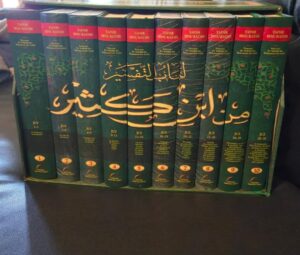
In addition to his contributions to history, Ibn Kathir’s work on the exegesis of the Qur’an, Tafsir al-Qur’an al-Azhim, also made a great contribution to Islamic knowledge. In this tafsir, Ibn Kathir did not merely provide the textual meanings of verses but also delved into the historical and social contexts that surrounded each revelation. He used a rigorous method, relying on the Qur’an, hadith, and authentic reports to explain the verses.
Tafsir al-Qur’an al-Azhim focused on deeper understanding of the Qur’anic texts, considering historical, linguistic, and theological aspects. One distinguishing feature of Ibn Kathir’s tafsir is his commitment to accuracy and precision in referencing reliable sources. In his work, he provided various explanations for the reasons behind the revelation of verses (asbab al-nuzul), which are important for understanding the true meanings of those verses. This demonstrates that tafsir must always be based on strong evidence and firmly grounded principles.
The primary contribution of Tafsir al-Qur’an al-Azhim is its emphasis on scientific methods in understanding revelation. Ibn Kathir stressed that tafsir must always be based on credible evidence and must adhere to sound principles. This teaches us that when interpreting sacred texts, we must be cautious and avoid speculative interpretations. Ibn Kathir’s tafsir encourages us to consider historical and social contexts when interpreting God’s revelations. A deeper understanding of sacred texts is necessary to apply religious teachings more accurately and correctly.
Criticizing Isra’iliyat: A Critical Approach to Historical Sources
One of the important aspects of Ibn Kathir’s works, both in history and tafsir, is his critical approach to Isra’iliyat stories (stories from Jewish and Christian traditions) that circulated in the Islamic world. Ibn Kathir did not reject all Isra’iliyat, but he carefully examined and assessed which ones aligned with Islamic principles and which were contrary to Islamic teachings. In Al-Bidayah wa an-Nihayah, he meticulously recorded stories from the Bible and Jewish sources, but he provided careful evaluations. If a story was in line with Islamic teachings, he accepted it; if it contradicted Islam, he rejected it.
This critical attitude holds high value in the study of Islamic history. We see that Ibn Kathir did not simply accept information at face value, but he conducted thorough analysis to determine the authenticity and relevance of these stories within the context of Islam. This approach teaches us that in historical research, we must be able to distinguish between reliable and unreliable sources. This attitude exemplifies the importance of critical thinking in history that we should not simply accept every story or narration without first verifying its accuracy.
Hadith Science and Precision in Narration: A Profound Lesson in History
Ibn Kathir is also well-known for his contributions to hadith science, having written the monumental work Al-Jami’ al-Kabir, which focused on the collection and evaluation of the narrations of Prophet Muhammad (SAW). In this work, Ibn Kathir demonstrated the importance of precision in evaluating the sanad (chain of narrators) and matan (content) of hadiths. He did not simply record authentic hadiths but also critically evaluated those that were weak or fabricated.
The method used by Ibn Kathir in compiling Al-Jami’ al-Kabir teaches us the importance of meticulousness in assessing historical sources, especially those related to religious teachings. In each hadith he recorded, he ensured that it could be justified scientifically. The lesson here is that any historical research, especially concerning religion, should be based on a scientific method and transparency in choosing sources. This demonstrates how Ibn Kathir paid special attention to accuracy and reliability when compiling sources for building our understanding of Islamic history.
Passing on the Tradition of Scientific Inquiry in Islamic History and Exegesis
Ibn Kathir’s precision and critical stance towards sources make his works a highly valuable legacy in the scientific history of Islam. His writings are not only essential in the study of history but also provide guidance on how we approach sacred texts and historical sources in general. Through Al-Bidayah wa an-Nihayah and Tafsir al-Qur’an al-Azhim, he introduced a way of writing and interpreting history and religious texts that emphasized accuracy, verification, and critical analysis values that are vital in the modern study of history and religion.
In conclusion, Ibn Kathir’s works, both in history and tafsir, serve as a model for the scientific study of historical events and sacred texts. He taught us that history should be approached with careful scrutiny, ensuring that all sources are critically evaluated and accurately recorded. His contributions have had a lasting impact on the way we study Islam and its history, providing future generations with the tools to understand the past in a more structured and scientifically grounded way.